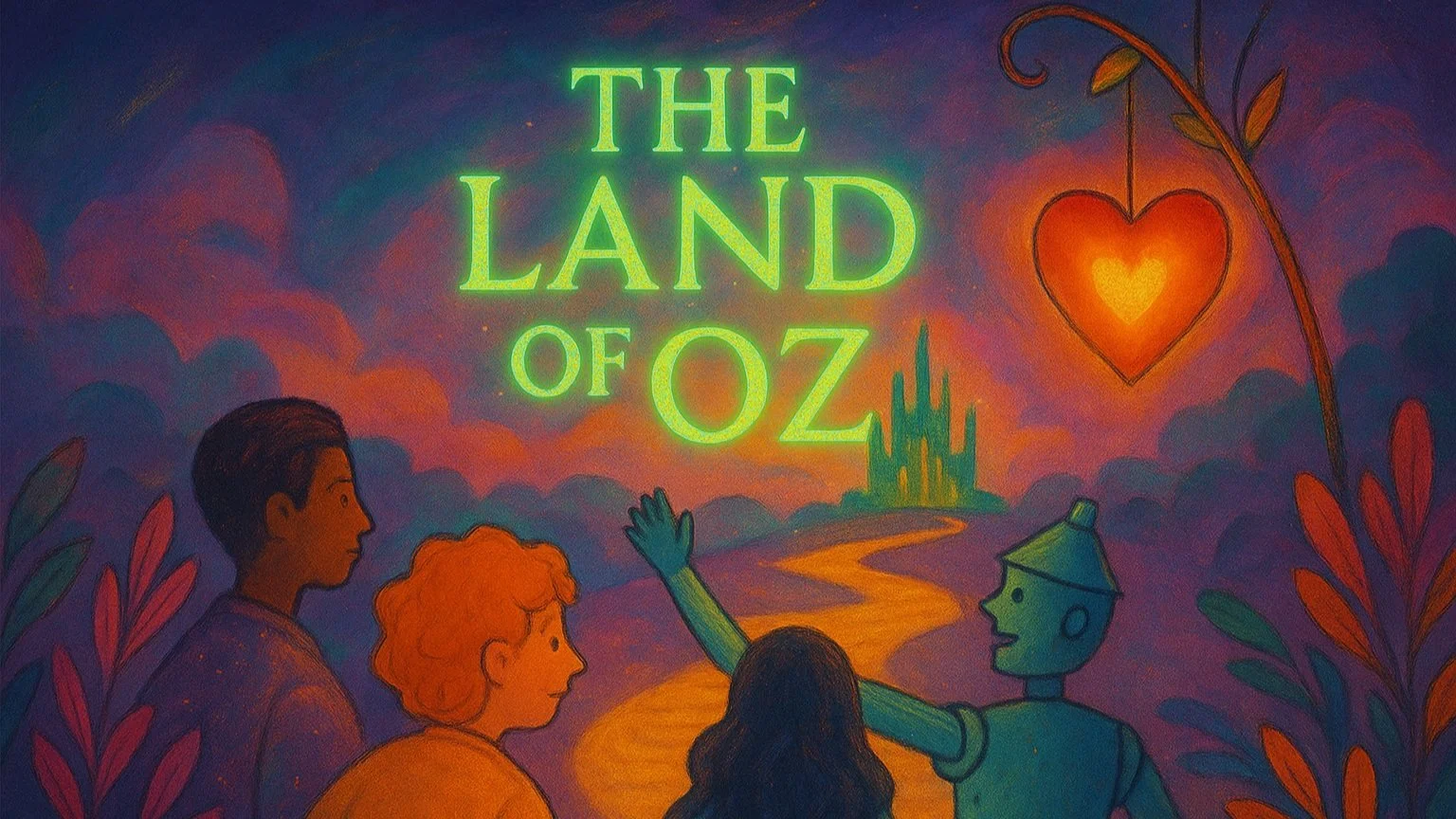
The Land of Oz is a five-part, immersive process drama project for children aged 8–12, co-created by Bee McQueen and Laurie Elliott. Set within a reimagined version of The Wizard of Oz, the project invites participants to step into role as both Munchkins and Flying Monkeys across a multi-session journey of collective imagination, ethical inquiry, and social-emotional exploration. Each session centres on a key question designed to deepen reflection and scaffold learning through character, story, and choice:
Session 1: What does bravery look like?
Session 2: How does fear affect our mind and body, and how can we bring it into balance?
Session 3: When should we act against authority?
Session 4: How can we practice compassion towards those who have wronged us?
Session 5: In what ways can we be changed by the people we meet in our lives?
Spanning celebrations, conflict, protest, and reconciliation, the drama follows the Munchkins as they uncover a mysterious poison threatening their land. As they journey beyond the safety of Munchkin Land, confront a misunderstood Witch, and negotiate justice with the Wizard of Oz, the participants grapple with complex emotional and ethical dilemmas through embodied play.
Using techniques such as Mantle of the Expert, Teacher-in-Role, collective storytelling, and ritual, The Land of Oz supports young people in exploring courage, empathy, transformation, and repair. The project champions process drama not only as a tool for imaginative engagement, but as a powerful model for participatory, values-based education.
Educational Aims & Pedagogical Approach
The Land of Oz was designed not as a tool to deliver predetermined outcomes, but as a shared process for young people to inhabit, explore, and transform complex questions through drama. Co-created and co-facilitated by Bee McQueen and Laurie Elliott, the project invited participants aged 8–12 to step into a fictional world that was both imaginative and structurally rigorous—scaffolded by learning questions, embodied inquiry, and ethical stakes.
At the heart of the approach was a deep commitment to fiction as a pedagogical space. In planning the drama, Bee drew on Neelands and Goode’s framework, recognising that successful immersion in fiction can be measured by participants’ investment during belief-building phases (Neelands & Goode, 2015, p.132). One early reflection noted that although the content of the initial lure—a diary entry found in Munchkin Land—was dramatically rich, its delivery lacked conviction, which risked disrupting immersion. As Clark et al.
remind us, “the active shaping of fiction assumes critical importance” (Clark et al., 1997, p.25). This learning led to future refinements that increased engagement through stronger performative choices and more conscious attention to how lures were introduced.
Teacher-in-role was a central technique throughout the process and was used not only to guide narrative, but to distribute power. As O'Neill writes, teacher-in-role “operates as an ‘anti-corrosive agent’ by deflecting students’ embarrassment and preventing them from feeling ‘stared at’” (O’Neill, 2014, p.38). The increased expressivity and participation observed after role-based facilitation affirmed its capacity to create emotional safety and group cohesion. Dorothy Heathcote herself noted, “Because I took part in role, it allowed them to gang up and acquire a common point of view” (O’Neill, 2014, p.137)—a principle Bee embodied to encourage collective agency and decision-making.
Physical embodiment was also central to the learning design. In Session 2, Bee adapted the Lecoq-derived “Seven States of Tension” to allow participants to explore fear somatically. This move not only aligned with the session’s learning question (How does fear affect our mind and body, and how can we bring it into balance?) but also modelled experiential learning. As Rogers defined it, learning becomes experiential when it is personally relevant, self-initiated, and emotionally and cognitively integrated (Rogers, 1969, p.5). Participants later identified fear as the cause of the Tin Man’s paralysis, evidencing deep, embodied comprehension.
This commitment to co-creation extended into narrative development. For instance, in Session 4, when a participant suggested disguising themselves as castle guards instead of flying monkeys, the facilitators abandoned the original plan and followed the children's logic. This moment of “high-level negotiation” exemplified Heathcote’s vision of teaching with attentiveness to both detail and significance: “We can only create moments when children stumble upon an authentic experience if we teach with attention to detail and its relation to the whole” (O’Neill, 2014, p.17).
The drama also worked as a critical pedagogy. When a participant in Session 3 shouted “Revolt! For the greater good!” upon learning of the Flying Monkeys’ oppression, it was a spontaneous demonstration of what Freire would describe as a “problem-posing” education—one that develops “power to perceive critically the way they exist in the world” (Freire, 1993, p.64). The fictional frame gave them both the freedom and the safety to rehearse liberation.
Pedagogically, The Land of Oz exists as a model of participatory learning where fiction is not an escape but a mirror, a rehearsal room, and a ritual. The young people were not passive receivers of a story; they were builders of belief, responders to crisis, ethical negotiators, and co-authors of change.
References
Clark, J. et al. (1997). Lessons for the Living: Drama and the Integrated Curriculum. Mayfair Cornerstone Ltd.
Cowley, S. (2006). Getting the Buggers to Behave. A&C Black.
Dawson, K. (2018). Drama-based Pedagogy: Active Learning Across the Curriculum. Intellect Books.
Freire, P. (1993). Pedagogy of the Oppressed. Penguin Books.
Freire, P. (2008). Education for Critical Consciousness. Continuum.
Neelands, J. & Goode, T. (2015). Structuring Drama Work. Cambridge University Press.
O’Neill, C. (Ed.). (2014). Dorothy Heathcote on Education and Drama: Essential Writings. Routledge.
Rogers, C. & Freiberg, H. J. (1969). Freedom to Learn. Merrill.
Credits
Created by: Bee McQueen & Laurie Elliott
Facilitated by: Bee McQueen & Laurie Elliott
Project Context: Contemporary Performance Practice student project, facilitated professionally as part of the Drama Short Courses Programme at the Royal Conservatoire of Scotland
Age Group: 8–12 years
Format: Process Drama / Applied Theatre (5 sessions)
Session Length: Approx. 90 minutes each
Special Thanks:
Gary Gardiner (Lecturer in Radical Pedagogy)
Aby Watson (Mentor)