
Om: I Remember
Om: I Remember is a ritualistic, live-art performance that navigates the tension between forgetting and remembering one’s innate divinity. Created and performed by Bee McQueen, the piece exists as an embodied invocation—a cyclical act of washing, revealing, and reckoning—that exposes the psychic ruptures caused by imperialism, capitalism, ableism, and the patriarchy at large. Positioned in the liminal space between pain and healing, the work confronts the external structures that pathologise neurodivergence and spiritual knowing, while also gesturing toward a cosmic memory, a pre-colonial wholeness that pulses beneath these systems.
Bee invites the audience to witness a process of devotional return, where spiritual and neuroqueer knowledge are not abstract concepts but felt experiences—ritualised through repetition, resonance, and refusal. The performance resists the demand for linear narrative or cathartic resolution, instead offering a durational rhythm of symbolic unveiling. Through this, Bee asks: What must be destroyed in order to remember what was always true?
References
Ahmed, Sara. The Cultural Politics of Emotion. Edinburgh University Press, 2004.
Hedva, Johanna. Sick Woman Theory. 2016. [Available online: https://www.maskmagazine.com/not-again/struggle/sick-woman-theory]
Hedva, Johanna. Minerva the Miscarriage of the Brain. Sming Sming Books & Wolfman Books, 2020.
Kafer, Alison. Feminist, Queer, Crip. Indiana University Press, 2013.
Lorde, Audre. The Cancer Journals. Penguin Classics, 2020.
Walker, Nick. “Toward a Neuroqueer Future.” In: Neuroqueer Heresies: Notes on the Neurodiversity Paradigm, Autistic Empowerment, and Postnormal Possibilities. Autonomous Press, 2021.
Yergeau, Melanie. Authoring Autism: On Rhetoric and Neurological Queerness. Duke University Press, 2018.
At the heart of Om: I Remember is a longing to return to something sacred that has been forcibly forgotten. For Bee, the performance was not just an artwork, but a devotional act—an invocation of spiritual memory buried beneath the violence of patriarchal structures, concepts, and ideologies. They approach the work through a spiritual-disability justice lens, asking what becomes possible when we no longer separate the political from the spiritual, the personal from the ancestral.
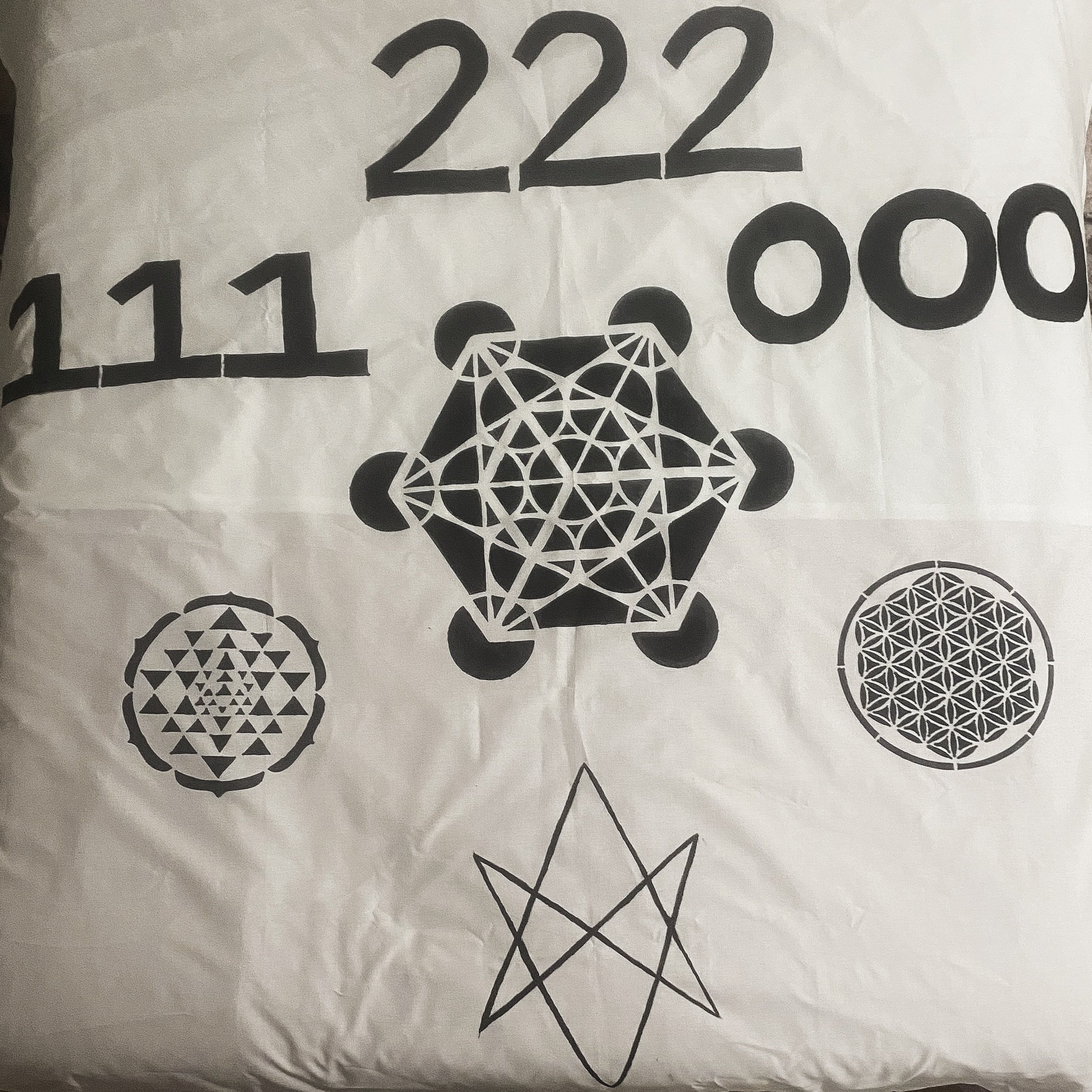
Bee’s intention was not to perform a linear story of healing, but to ritualise a form of remembering. The repetition of writing, washing, excavating, and unveiling was scored as a devotional cycle—a ritual architecture shaped by rhythm, energy, and resistance. Rather than building to a climax, the performance unfolds through slow revelation. The shrine, initially hidden, is gradually exposed: a dust sheet inscribed with sacred geometry (Metatron’s Cube, the Flower of Life, the Sri Yantra, the Unicursal Hexagram) and numerological symbols (222, 111, 000). These motifs are chosen not for aesthetic value alone, but as active frequencies and spiritual technologies—literal metaphors of divine architecture, multiplicity, and encoded truth.
Bee draws on Johanna Hedva’s Sick Woman Theory, which argues that “the body is a site of knowledge, resistance, and refusal” (Hedva, 2016). Within this framing, the act of being present, vulnerable, and nonlinear becomes an embodied protest against a world that demands legibility, utility, and recovery. Similarly, Nick Walker’s concept of neuroqueerness as a "practice of intentional noncompliance" (Walker, 2021) informs the work’s structure. Bee rejects narrative coherence in favour of symbolic resonance, aligning with what Alison Kafer describes as “crip time”—a temporal orientation that values slowness, cyclical repetition, and suspended futurity (Kafer, 2013).
Om: I Remember is not about overcoming suffering, but honouring the layers of forgetting imposed by structural violence—and holding space for the vibrational truths that remain. Bee performs as both seeker and shrine, not offering answers but activating a remembering. Through this, the work becomes a ritual of resistance, a song of refusal, and a call back to what was never truly lost.
Artistic Intentions
Staging & Aesthetics
The staging of Om: I Remember was both intimate and elemental. A basin of water nested inside a bathtub stood at the centre of the space—part altar, part cleansing pool. Around it, a slow-building architecture of ritual emerged, formed through action and accumulation. Bee’s body served as both site and medium, marked with shaming phrases such as “You should earn your rest,”“Council scum,”“You should control yourself,” and “You’re a burden.” These statements, repeated across the body, carried the haunting refrain of systemic harm: “You should...” Recalling Hedva’s assertion that “a broken body is a body with agency,” the piece rejected the redemptive arc in favour of cyclical return—ritualising shame into sovereignty (Hedva, 2016).
These inscriptions were not for spectacle but functioned as offerings—each one a sediment of remembered harm to be ritually witnessed and released. The phrases bore the tone of systems speaking directly to Bee, seeking to collapse them into silence. The presence of these oppressive phrases on their body was Bee’s refusal to disappear.
The scenography evolved over time rather than being presented in full. Cotton, initially part of the design, was removed in later stages, allowing focus to shift to the core elements: water, body, fabric, and light. The gradual unveiling of the shrine—painted with sacred symbols—was choreographed across cycles of action, creating a slow-burning dramaturgy of revelation. These symbols were chosen for their spiritual and energetic significance:
Flower of Life – unity and genesis
Sri Yantra – divine feminine and the path to source
Unicursal Hexagram – integration of opposites
Metatron’s Cube – divine balance and multidimensionality
Numerology: 222 (balance), 111 (new beginnings), 000 (void and source)
The aesthetic composition of Om: I Remember is another example of Bee’s neuroqueer literal metaphor methodology where patriarchical oppression literally stains their body and is washed off in a repeating cycle, and then the semiotics of the divine shrine’s gradual reveal embodies the poetry of the healing and remembering process. Finally, the literal smashing of the clock also holds metaphorical weight - a refusal of linear healing, a rejection of the notion there is a deadline on self-evolution, and a rebellion toward normative structures sculpted by the hands of oppressive systems. This became a ritual of refusal, resisting productivity, recovery arcs, and the demand for closure—what Kafer (2013) describes as the “straight time” of ableist futures. The decision to perform bare-chested (while wearing pants) was a gesture of disarmament, resisting both sexualisation and shame.
The performance did not invite audience participation, but instead asked them to hold space—to witness without controlling. The architecture of the work resisted consumption and offered, instead, a shared field of sacred presence. Vulnerability here was not a weakness to be overcome but a power to be honoured.
References
Hedva, J. (2016). Sick Woman Theory. Mask Magazine.
Kafer, A. (2013). Feminist, Queer, Crip. Indiana University Press.
Credits
First Performed: June 2025 at Wallace Studios, Royal Conservatoire of Scotland, for an invited audience.
Performed and Created by:
Bee McQueen
Special Thanks:
Kirsty Paton (Stage Manager)
Louise Van Tassel (Sound Composition)
Dianne McConnell (Veil & Shrine Fabrication Support)
Laura Gonzalez (Mentor)
Bojana Jankovic (Mentor)
Lucas Chih-Peng Kao (Videographer)