If I Show You Mine,
Will You Show Me Yours?
If I Show You Mine, Will You Show Me Yours? is a solo performance that inhabits the fragmented terrain of ADHD and queerness—not as subject matter, but as method. Built around speech-to-text technology that mirrors the performer’s processing delay, the work resists traditional narrative and embraces associative drift, tangents, glitch, and embodied stammer.
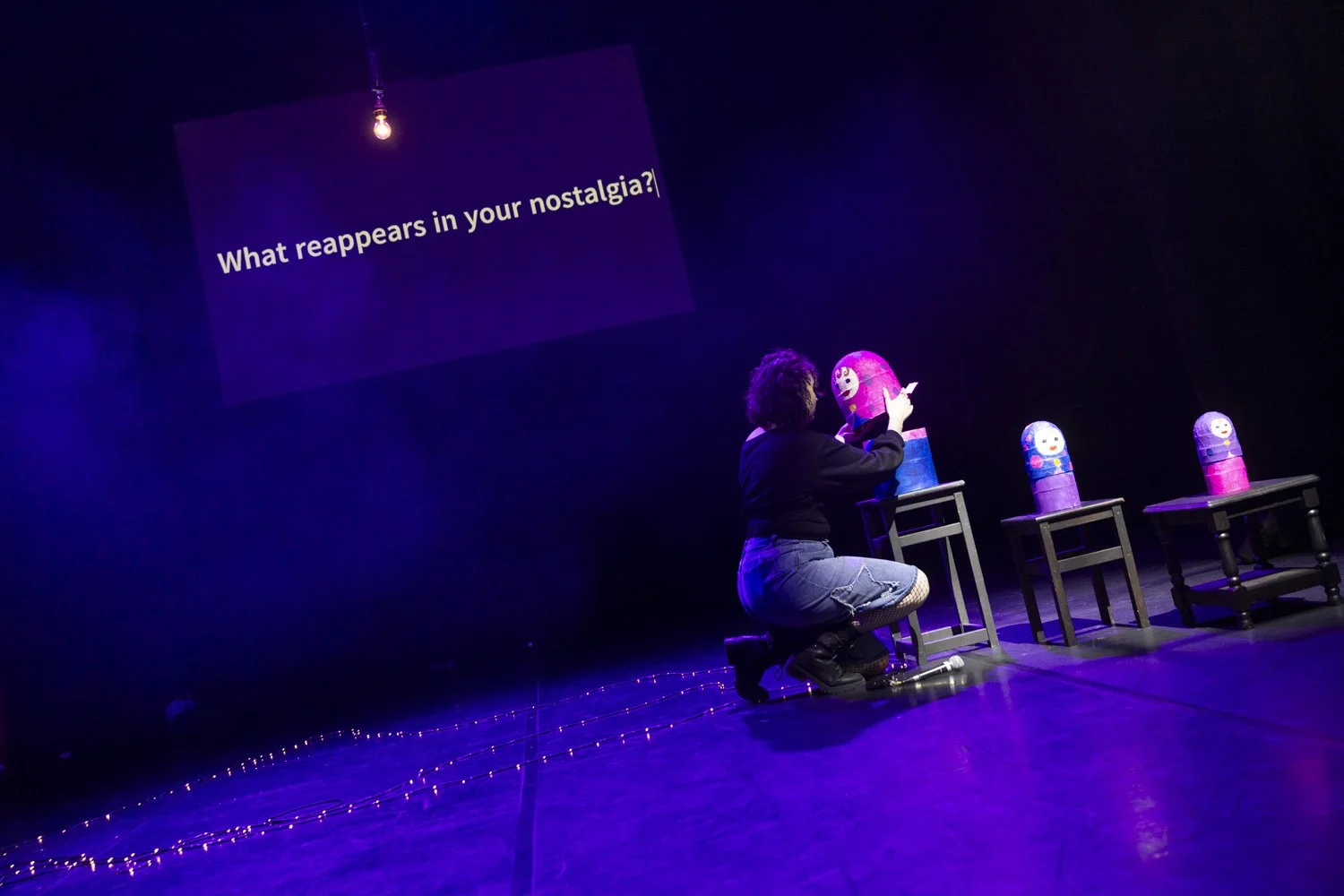
Rather than telling the audience what ADHD is, Bee McQueen invites them into the experience of it. Text appears broken, nonlinear. Moments repeat. False starts abound. Across this neuroqueer dramaturgy, Bee crafts an unfolding collage of self-revelation, punctuated by an archive of questions projected throughout the show—ranging from the profound to the playfully mundane.
The piece is driven by a desire to understand how we come to know one another in meaningful ways. It is about the tension between connection and exposure, between small talk and intimacy, between shame and the deep wish to belong. One moment finds Bee hosting “small talk” with the audience; another has the audience offering Bee a question that they answer to finish the show. The work holds its vulnerability with sharp humour and unapologetic tenderness.
This work emerged from an inquiry into Bee’s own neurocognitive functioning. Observing the rhythms of their internal processing—the delays, leaps, tangents, interruptions—they allowed those patterns to shape the dramaturgy. Inspired by neuroqueer and crip theory, the piece questions what performance can look and feel like when normative timelines, emotional arcs, and communication structures are cast aside. Instead, it leans into stammer, silence, tangents, and associative logic as tools for meaning-making.
If I Show You Mine is not about ADHD; it is made with ADHD. It is not about queerness; it is queer in its refusal of fixity. At its core, the work searches for belonging—emotional, interpersonal, and ontological—whilst questioning the persistent ache of loneliness in its margins. It is a performance that invites us to ask, again and again, how we might truly see and be seen.
Artistic Intentions
Neuroqueer Aesthetics & Composition
As a neurodivergent person, Bee often intakes and processes things literally. As a poet, they speak & communicate in metaphor. Their work (and life) harmonise and oscillate in the tension between these two modes of meaning-making. Over the years, Bee recognised this as an ontological dialogue between them and the world - receiving everything literally and giving everything metaphorically. It was a pervasive alchemical pattern between understanding and expressing, and provided fertile ground to develop their neuroqueer methodology, Literal Metaphor. They experimented with it firstly during their Prison of Perfection project, where a chip was fixed to their shoulder. This approach evolved further in Dear God, and finds new layers in If I Show You Mine, Will You Show Me Yours?
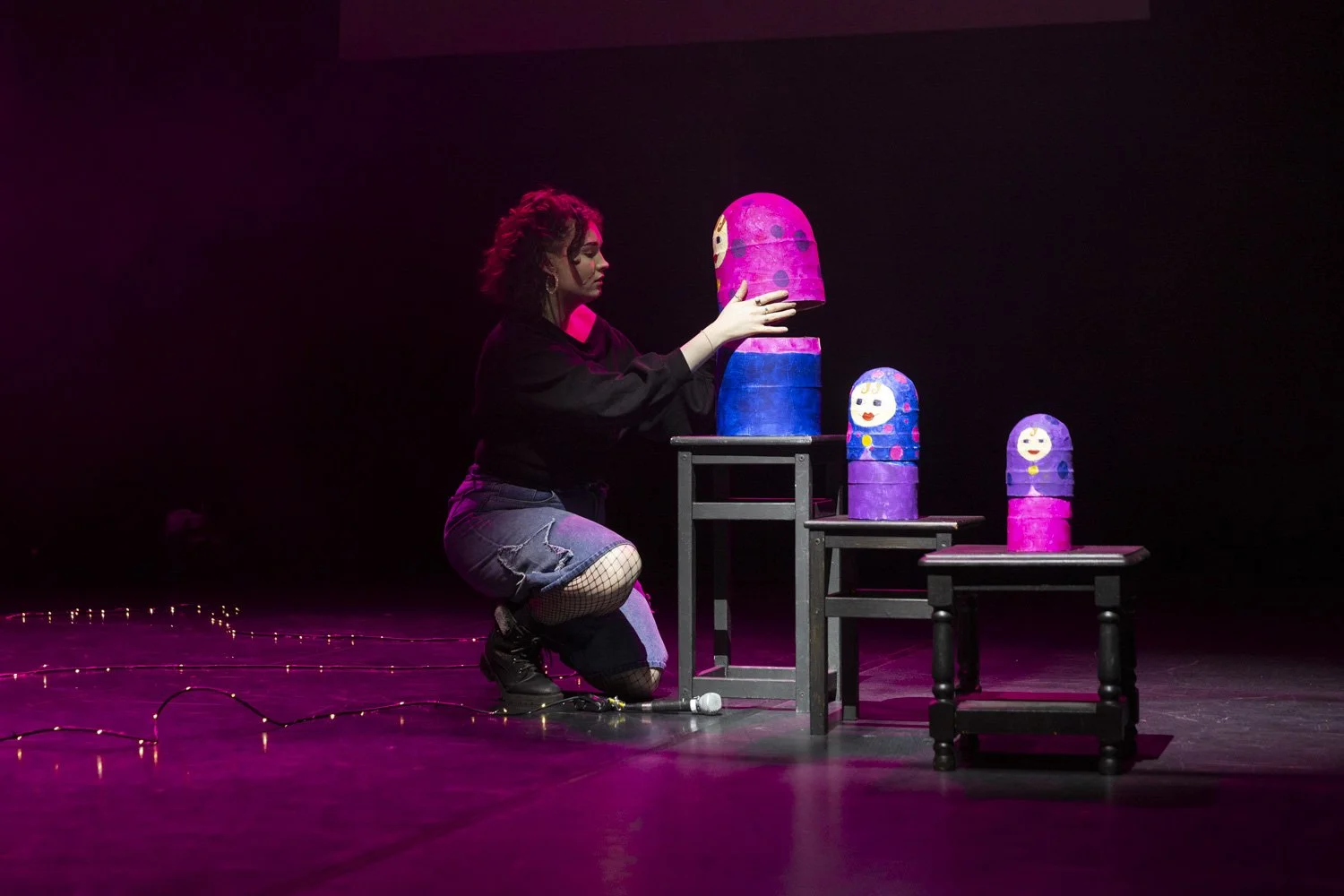
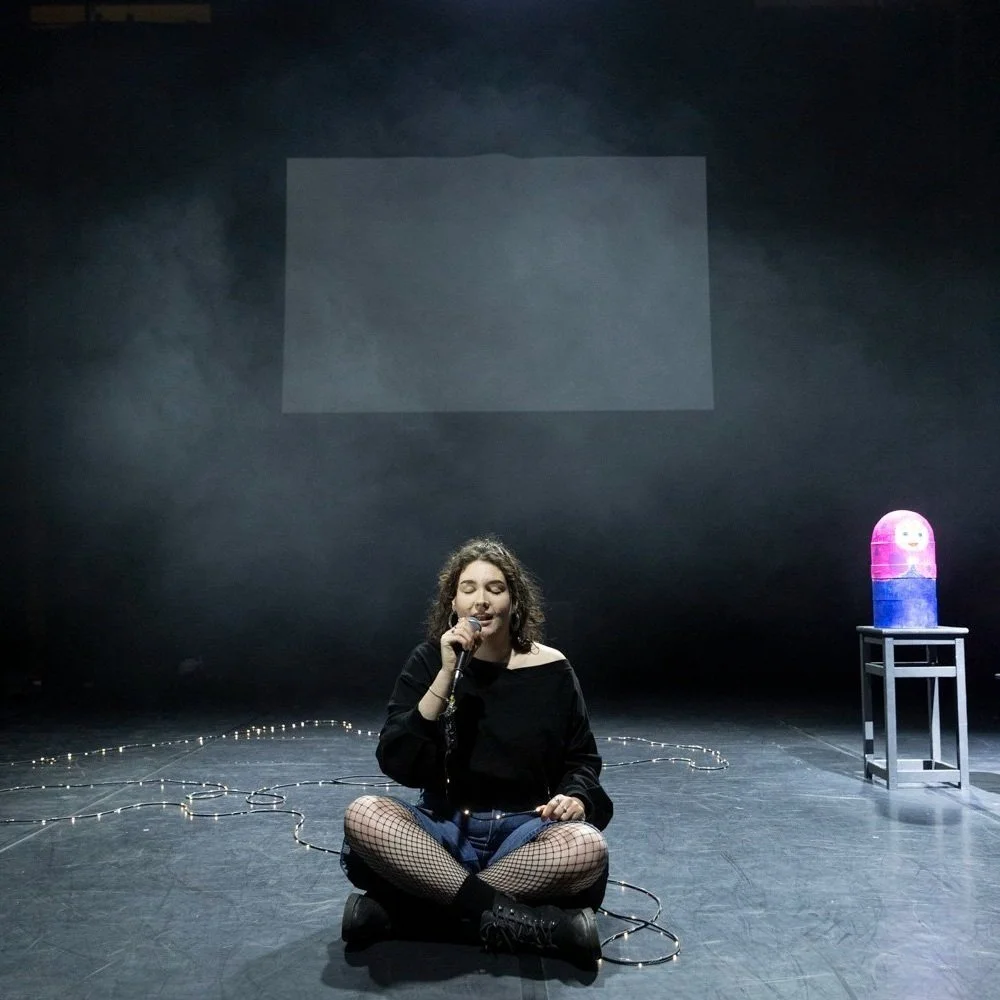
In this piece, literal metaphors operate as dramaturgical anchors. A lightbulb becomes a signifier for cognitive overwhelm and revelation. The speech-to-text delay, more than a tool, mirrors real-time processing lag. Russian dolls gesture toward the multifaceted, layered, and ever-evolving self. Fairy lights wrapped around a microphone evoke stardust, soft power, and the intimate spectacle of being heard.
These images are not decorative. They are poetic architecture—strange, sparkling, and specific to the neuroqueer bodymind they emerge from.
Credits
Created and Performed by: Bee McQueen
Project Context: Contemporary Performance Practice degree show developed at the Royal Conservatoire of Scotland
Format: Live-art, neuroqueer, participatory performance with live speech-to-text integration
Runtime: 30 minutes
First Performed: Into the New Festival, CCA Glasgow, 14th & 15th February 2025
Special Thanks:
Daniel Oliver (Mentor)
Louise Van Tassel (Sound Composition)
Ruby Noble (Stage Manager)
Julia Bauer (Photographer)
Lucas Chih-Peng Kao (Videographer)